


 Español

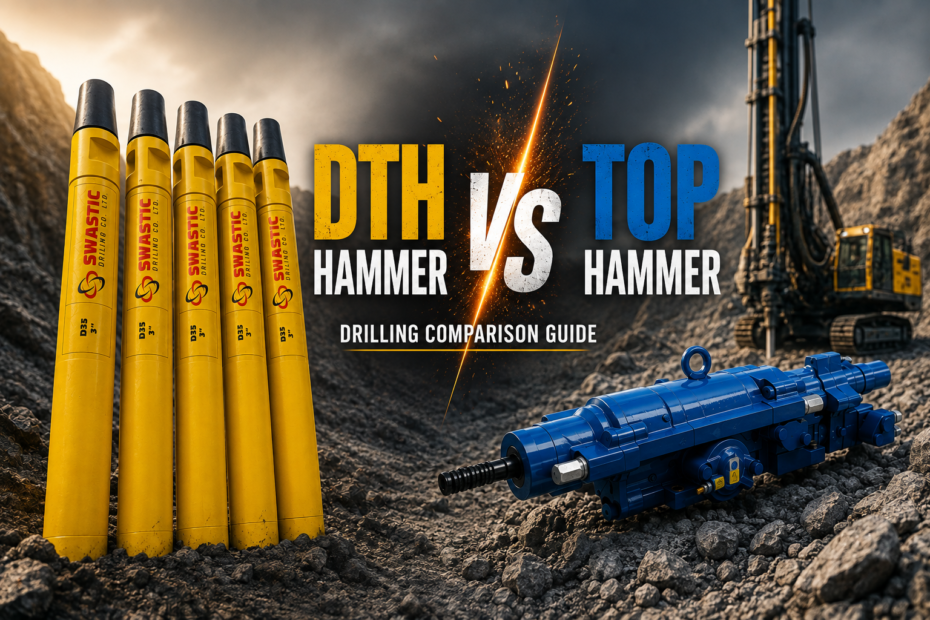
Choosing the right drilling system is essential for maximizing productivity, drilling accuracy, and overall project efficiency in mining and hard rock applications.
Two of the most widely used rock drilling technologies are Down-the-Hole (DTH) drilling and Top Hammer drilling. While both are designed for demanding rock drilling applications, they differ significantly in how impact energy is transferred, the depths at which they perform best, hole accuracy, tooling requirements, and operating economics.
In this guide, we compare DTH Hammer vs Top Hammer drilling across key factors including working principle, drilling depth, penetration performance, hole straightness, geology, cost, and applications—helping you identify the most suitable drilling system for your mining, quarrying, tunnelling, construction, or other hard rock drilling project.
What is a DTH Hammer?
A Down-the-Hole (DTH) Hammer is a pneumatic drilling tool that uses compressed air to drive an internal piston at high frequency. The piston repeatedly strikes the drill bit positioned directly at the bottom of the borehole, transferring impact energy directly to the rock.
Because the hammer operates at the bottom of the hole, close to the drilling face, relatively little impact energy is lost as drilling depth increases. This makes DTH drilling particularly effective in hard and abrasive rock formations, especially where maintaining straight and accurate holes is important.
When combined with the correct DTH Bits, drill pipes, and air compressor, a properly configured DTH system can deliver consistent penetration, good hole quality, and reliable performance in demanding drilling conditions.
Main Components of a DTH Hammer
- Backhead – Connects the hammer to the drill pipe and directs compressed air.
- Internal Piston – Generates the impact energy required to break the rock.
- Cylinder – Guides the movement of the piston inside the hammer.
- Chuck – Holds and guides the DTH bit.
- Retaining Ring – Helps retain the bit within the hammer during operation.
- DTH Bit – Transfers the hammer’s impact energy to the rock through tungsten carbide buttons.
What is Top Hammer Drilling?
Top Hammer drilling uses a hydraulic or pneumatic rock drill, commonly known as a drifter, mounted on the drilling rig. The impact energy is generated at the drill rig and transmitted through the shank adapter, drill rods, and coupling sleeves before reaching the drill bit.
Unlike DTH drilling, where the hammer operates directly behind the bit, Top Hammer percussion originates outside the borehole. As the impact energy travels through the drill string, some energy is lost during transmission, particularly as drilling depth increases.
Top Hammer systems, however, can deliver excellent penetration rates in shallow to medium-depth holes. This makes them particularly suitable for applications such as quarry bench drilling, tunnelling, underground development, construction, and rock bolting, where fast drilling cycles and productivity are important.
Main Components of a Top Hammer System
- Drifter – Generates high-frequency percussion and rotation.
- Shank Adapter – Transfers impact and rotation from the drifter to the drill string.
- Extension Drill Rods – Transmit percussion and rotation toward the drill bit.
- Coupling Sleeves – Connect individual drill rods to form the required drill string length.
- Top Hammer / Button Bit – Transfers impact energy to the rock and fractures the formation.
- Feed Beam – Guides the drilling assembly and applies the required feed force.
DTH Hammer vs Top Hammer: Complete Comparison
The fundamental difference between the two systems is where the impact energy is generated. In DTH drilling, percussion occurs directly behind the bit at the bottom of the hole. In Top Hammer drilling, percussion is generated by the drifter and transmitted through the drill string to the bit.
| Feature | DTH Hammer | Top Hammer |
| Impact Location | At the drill bit | At the drill rig |
| Energy Loss | Very Low | Moderate |
| Hole Straightness | Excellent | Good |
| Best Hole Depth | Medium to Very Deep | Shallow to Medium |
| Rock Suitability | Hard & Abrasive Rock | Medium to Hard Rock |
| Drilling Accuracy | Very High | High |
| Rod Wear | Lower | Higher |
| Surface Noise | Lower | Higher |
| Initial Investment | Higher | Lower |
| Cost Efficiency | Better for deeper drilling | Better for shallow drilling |
These differences do not mean that one drilling system is universally better than the other. The optimum choice depends on factors such as hole depth, hole diameter, rock formation, required accuracy, production targets, equipment configuration, and operating conditions.
Advantages and Limitations of DTH and Top Hammer Drilling
Advantages of DTH Hammer Drilling
- Excellent hole straightness – Impact energy is delivered directly behind the bit, helping maintain drilling accuracy as depth increases.
- Low energy loss – Because the hammer operates at the bottom of the hole, impact energy does not have to travel through a long drill string.
- Strong hard-rock performance – Particularly effective in hard and abrasive formations.
- Suitable for deeper holes – Performance remains relatively consistent as drilling depth increases.
- Lower drill-string wear – The drill pipes primarily transmit rotation and air rather than repeated percussion energy.
Limitations of DTH Hammer Drilling
- Requires a suitable compressed-air supply.
- Compressor requirements can increase significantly with hole diameter and depth.
- Initial equipment investment can be higher.
- May not be the most economical choice for very shallow drilling.
- Larger compressor and support equipment may be required for demanding applications.
Advantages of Top Hammer Drilling
- High penetration rates in shallow and medium-depth holes.
- Fast drilling cycles can provide excellent productivity.
- Well suited to quarrying, tunnelling and construction.
- Effective for bench drilling and underground development.
- Generally requires a lower initial investment for many applications.
- Compact and mobile drilling configurations are available.
Limitations of Top Hammer Drilling
- Impact energy must travel through the complete drill string.
- Energy losses generally increase as the drill string becomes longer.
- Drill rods, shank adapters and coupling sleeves experience greater percussion-related wear.
- Maintaining hole straightness becomes more challenging as drilling depth increases.
- Generally less suitable than DTH for very deep holes.
The practical significance of these advantages and limitations depends on the specific drilling conditions. A system that delivers the lowest cost per metre in a shallow quarry application may not provide the same advantage in a deep hard-rock drilling project.
Geology Suitability: DTH Hammer vs Top Hammer
Geological conditions strongly influence drilling performance. Rock hardness alone does not determine the best drilling method—abrasiveness, fracturing, formation consistency, hole depth, hole diameter, and required hole straightness should also be considered when selecting between DTH and Top Hammer drilling.
| Geological Formation | DTH Hammer | Top Hammer |
| Granite | Highly Suitable | Highly Suitable |
| Basalt | Highly Suitable | Highly Suitable |
| Quartzite | Highly Suitable | Suitable |
| Limestone | Suitable | Highly Suitable |
| Sandstone | Suitable | Highly Suitable |
| Coal Overburden | Suitable | Suitable |
| Mixed Formations | Highly Suitable* | Suitable* |
| Softer Rock | Application Dependent | Highly Suitable |
Performance in mixed formations can vary considerably depending on changes in hardness, fractures, voids, abrasiveness, and ground stability. Actual drilling conditions should therefore be evaluated before selecting the drilling system and tooling.
As a general principle, DTH drilling becomes increasingly attractive in harder formations and deeper holes where maintaining hole straightness is important, while Top Hammer drilling can provide excellent productivity in shallow to medium-depth holes where rapid drilling cycles are the priority.
Applications of DTH Hammer and Top Hammer Drilling
Both drilling technologies are used across mining, quarrying and infrastructure projects, but their suitability changes according to hole depth, diameter, geology, accuracy requirements and production objectives.
Common DTH Hammer Applications
- Surface mining and blast-hole drilling
- Hard Rock Mining
- Water-well drilling
- Foundation and piling work
- Geothermal drilling
DTH drilling is particularly valuable where deeper holes, hard rock, consistent hole diameter and good hole straightness are important to the operation.
Common Top Hammer Applications
- Quarry bench drilling
- Tunnel development
- Underground development
- Rock bolting
- Construction and infrastructure projects
Top Hammer drilling is particularly effective where fast penetration, shorter holes, frequent repositioning and high drilling-cycle productivity are required.
Cost Per Meter: DTH Hammer vs Top Hammer
The lowest equipment price does not necessarily result in the lowest drilling cost per meter. Actual drilling cost depends on several variables, including rock hardness, hole depth and diameter, penetration rate, compressor or power requirements, fuel consumption, drill-bit life, drill-string wear, maintenance, labour, and overall machine utilization.
Key Factors Affecting Drilling Cost
| Cost Factor | DTH Hammer | Top Hammer |
| Initial Equipment Investment | Generally Higher | Generally Lower |
| Shallow-Hole Cost Efficiency | Moderate | High |
| Deep-Hole Cost Efficiency | High | Lower as depth increases |
| Drill-String Wear | Generally Lower | Generally Higher |
| Compressor Requirement | Significant | Application dependent |
| Hard-Rock Performance | Excellent | Good to Excellent |
These comparisons are general guidelines rather than fixed cost rules. The most economical system should be evaluated using the total cost per drilled meter for the actual site conditions, rather than equipment purchase price alone.
How to Choose Between DTH and Top Hammer Drilling
The right drilling system should be selected based on the complete application rather than a single performance parameter. Hole depth, rock conditions, required accuracy, production targets, available equipment, and operating cost should all be considered together.
| Project Requirement | Generally Preferred | Why |
| Deep hard-rock holes | DTH | Efficient energy transfer at depth |
| Maximum hole straightness | DTH | Impact occurs directly behind the bit |
| Shallow quarry holes | Top Hammer | High penetration and fast cycles |
| Tunnel development | Top Hammer | Speed and positioning flexibility |
| Long-hole production drilling | DTH | Strong performance at greater depth |
| Frequent repositioning | Top Hammer | Well suited to rapid drilling cycles |
These recommendations should be treated as a starting point. Final equipment and tooling selection should consider the actual geology, hole diameter, drilling depth, available air or hydraulic power, and production requirements of the project.
Conclusion
Both DTH and Top Hammer drilling have important roles in mining, quarrying, tunnelling, construction and hard-rock drilling. DTH is generally better suited to deeper holes and applications where hard-rock performance and hole straightness are critical, while Top Hammer is particularly effective for shallow to medium-depth drilling where penetration rate, mobility and rapid drilling cycles are priorities.
The right system ultimately depends on the geology, hole dimensions, production requirements and total cost per drilled meter.
Need Help Choosing the Right Drilling Solution?
At Swastic Drilling Company Limited, we manufacture and supply DTH Hammers, DTH Bits, drilling accessories, and Top Hammer solutions for demanding mining and rock-drilling applications.
Not sure which system is right for your project? Share your hole diameter, drilling depth, rock formation, application, and current drilling setup with our technical team. We can help you identify the most suitable drilling solution for your requirements.

